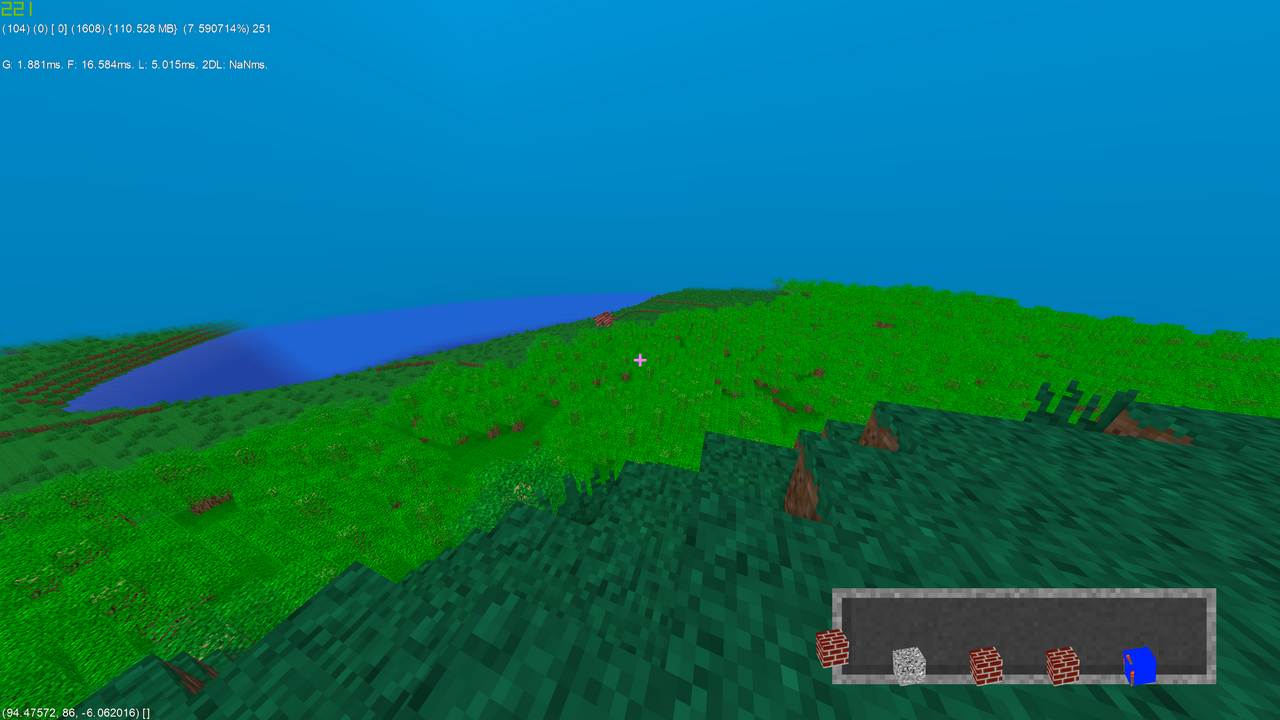
CMine was born out of curiosity. During my university years, I wanted to challenge the assumption that managed languages like C# were too slow for intensive voxel engines.
The goal was simple but ambitious: replicate the core mechanics of Minecraft while maximizing frame rates. By leveraging modern OpenGL (DSA) and strict memory management, the engine creates infinite procedural worlds capable of running at 900+ FPS on 1080p, proving that C# is a viable candidate for high-performance graphics when the Garbage Collector is tamed.
Engineering Features
Unlike standard implementations that rely on 2D chunk columns (limiting height), CMine implements a fully volumetric chunking system.
:: Infinite Verticality
The world is not limited by height. The chunk system is 3-dimensional, having each chunk a size of 16*16*16 blocks. This allows for the existence of deep underground caverns or floating islands that extend infinitely upwards and downwards.
:: Modern OpenGL (OpenTK)
Bypassed the legacy fixed-function pipeline. It utilizes Direct State Access (DSA) and Vertex Buffer Objects (VBOs) to batch geometry uploads, minimizing driver overhead.
:: Flood-Fill Lighting
Implements a cellular automaton algorithm for propagating light. Sunlight and block light (torches) are calculated on the CPU and baked into vertex attributes for zero-cost rendering.
:: Custom Block Models
Support for non-cubic geometry. It renders complex shapes like Slabs and Liquid surfaces without breaking the voxel grid optimization logic.
Technical Challenges
Writing a voxel engine in a garbage-collected environment presents unique hurdles compared to C++.
The Garbage Collector Spike
Generating chunks involves processing millions of blocks. In C#, allocating a class for every block would trigger massive Garbage Collection pauses, causing “stutter” every few seconds.
I implemented a Struct-based Architecture. Blocks are lightweight structs (value types) packed into
flat arrays. Mesh generation reuses a single shared memory buffer, ensuring zero allocations during the
render loop.
Hidden Face Culling
A naive renderer draws every block (6 faces). In a scene with 10,000 blocks, that’s 120,000 triangles, most of which are hidden underground.
The mesher performs a neighbor check before generating geometry. If a block face is touching another opaque block, it is discarded from the mesh. This reduces the triangle count by ~80-90%, which is the secret behind the 900 FPS performance.
Legacy & Impact
CMine holds a special place in my career: it was my very first 3D Graphics project.
Before this, I had no experience with OpenGL or 3D mathematics. Building a high-performance voxel engine from scratch was my introduction to Computer Graphics. It set the foundation for everything that followed, from my Bachelor’s Thesis to my Ph.D. research in Vulkan and Mesh Shaders.