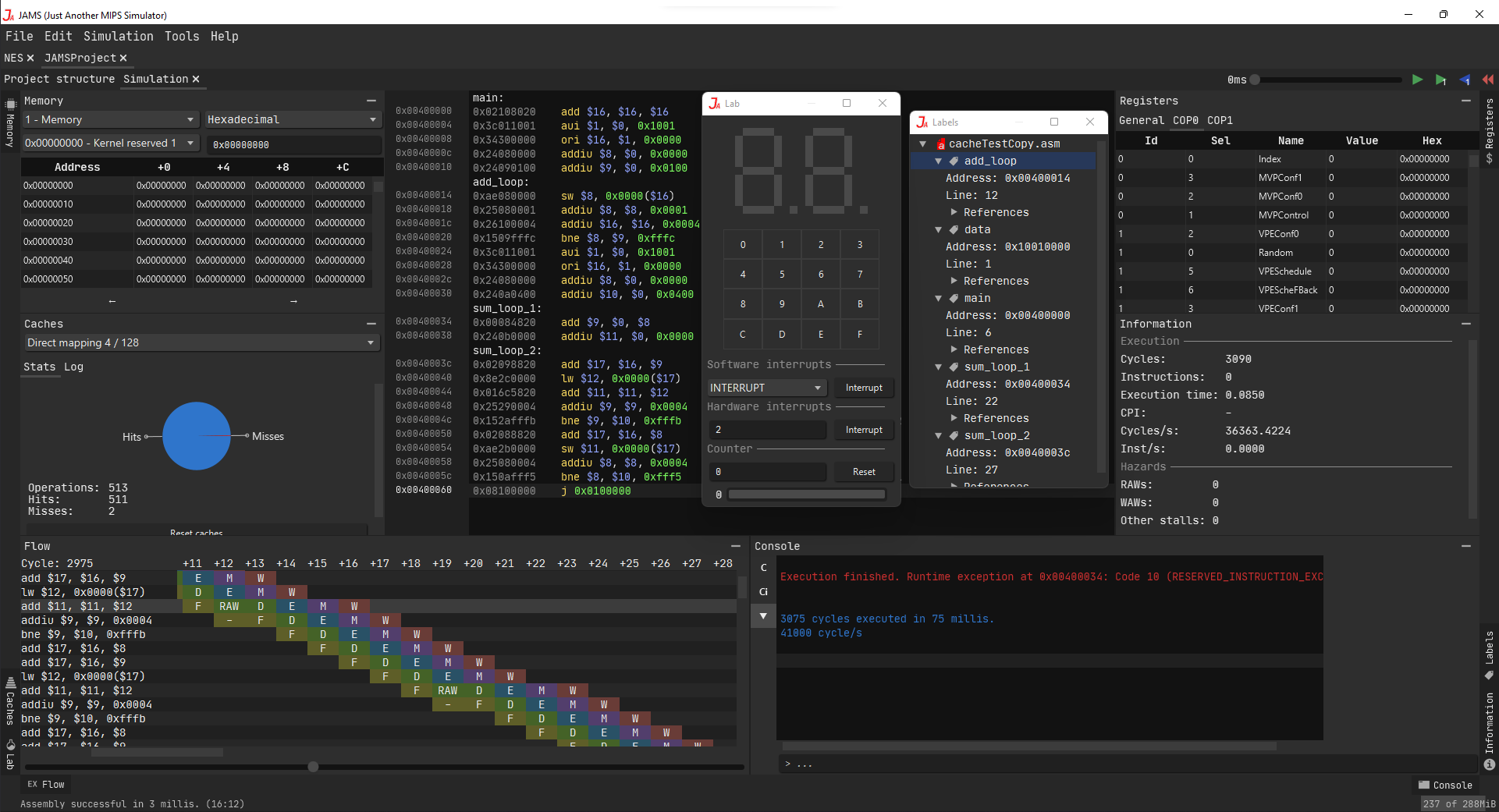
JAMS (Just Another MIPS Simulator) started as an educational tool but evolved into a fully-fledged IDE Platform. It represents the combined work of two Bachelor’s Theses: one focused on the Core Architecture and MIPS implementation, and the other on the Plugin System and NES integration.
My goal was not just to build a simulator, but to engineer a generic foundation capable of hosting any instruction set architecture (ISA) through a robust plugin ecosystem, mirroring the philosophy of platforms like IntelliJ IDEA.
The IDE Workspace
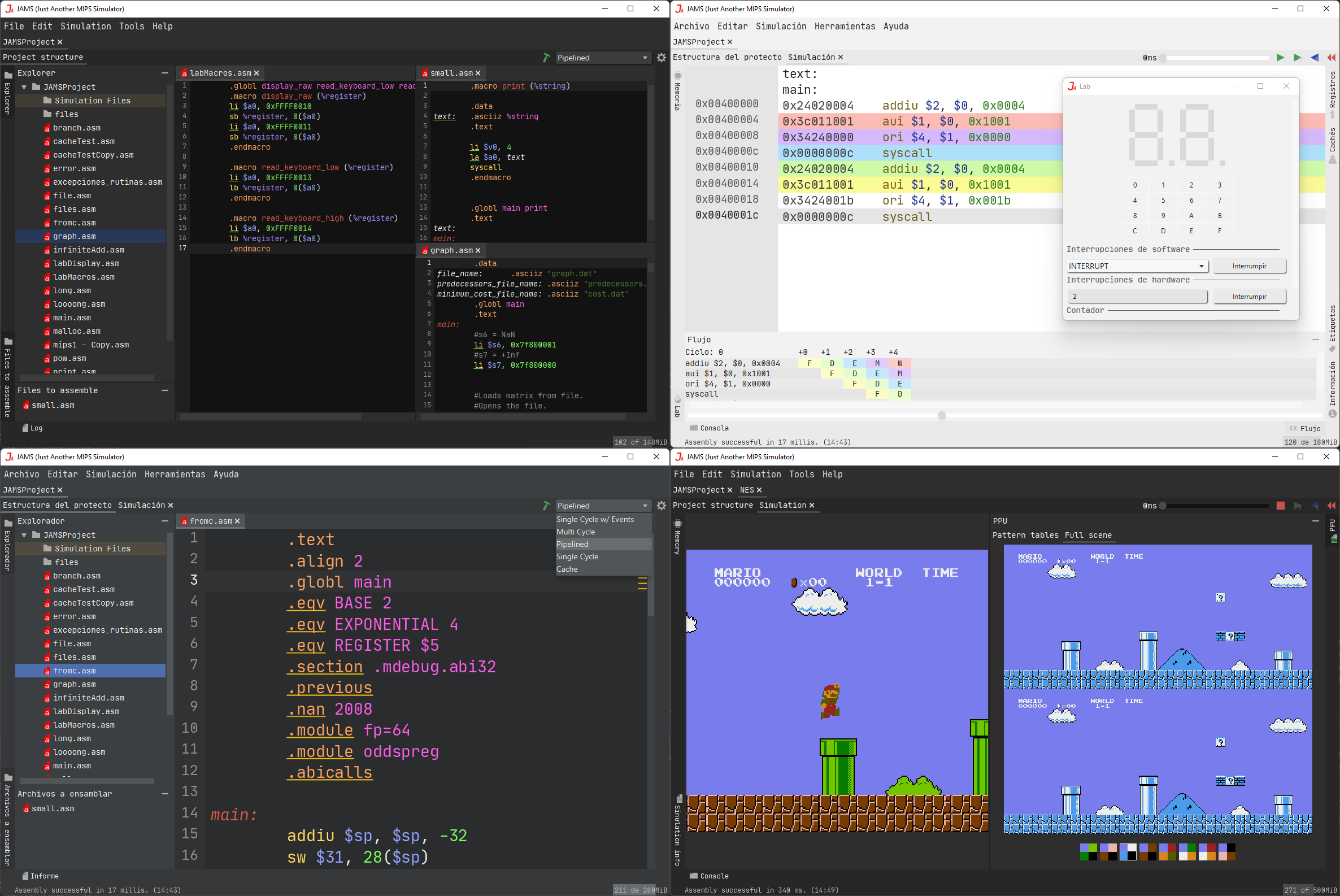
JAMS provides a professional-grade desktop environment. I engineered a custom Docking System based on “Nodes”, allowing users to organize their workspace dynamically. Tools can be anchored to the editor’s edges or detached into floating windows for multi-monitor setups.
:: CSS-Driven Theming
The UI styling is decoupled from logic using CSS.
The theme engine supports inheritance and variable definitions (global.css),
allowing users to create and hot-swap themes (e.g., Dracula, Light, Dark)
without restarting.
:: Hot-Swappable I18n
A robust localization system based on YAML/JSON packs. It supports Unicode and fallback chains, enabling instant language switching at runtime.
:: Context-Aware Actions
User interactions are abstracted into Actions. The system validates context (e.g., “Can I copy here?”) and handles key-binding mapping automatically, similar to the Command Pattern.
:: Decentralized Event Bus
Inspired by Minecraft modding APIs (Spigot/Sponge).
Components and plugins communicate via strongly-typed events using @Listener annotations,
supporting cancellation flows and generic types.
Core Architecture: Extensibility First
JAMS was architected to be more than just a MIPS simulator; it is a generic platform for assembly development. While it ships with a fully integrated, high-performance MIPS32 environment out of the box, the internal architecture exposes its core systems (Editor, Assembler pipeline, Simulation loop) through a public API.
This design allows external plugins to inject new architectures that coexist seamlessly with the native MIPS environment, leveraging the same UI components and build tools.
:: Native MIPS Integration
The default MIPS32 environment is built directly on top of the core API, serving as the reference implementation for performance and feature completeness.
:: The Manager Registry
Implements a Service Locator pattern. Core subsystems (Languages, Themes, Compilers) are exposed via Managers, allowing plugins to register new implementations at runtime.
:: Asynchronous VFS
A thread-safe Virtual File System abstraction that decouples the editor from the physical disk, enabling features like in-memory compilation and undo/redo stacks without IO blocking.
:: Dynamic ClassLoading
External plugins (JARs) are loaded via isolated URLClassLoaders. This allows the application to discover and link new modules at startup without modifying the classpath.
Advanced Editor Engineering
The crown jewel of JAMS is its text editor. Unlike simple syntax highlighters, I implemented a full Language Server architecture from scratch on top of RichTextFX to support deep semantic analysis.
1. Asynchronous MVC Architecture
To handle large assembly files (thousands of lines) without freezing the UI thread, the editor uses a strict Model-View-Controller separation with asynchronous updates:
- The Model: Implements a custom Rope data structure (hierarchical tree of elements) rather than a flat string. Elements are immutable-ish, optimizing memory for large files.
- The Update Loop: Edits are batched, compressed (discarding redundant keystrokes), and processed on a background thread. The View is only notified when the AST is rebuilt.
2. Semantic Analysis & Scoping
The editor understands the code structure. It maintains a Project Global Index that tracks symbols across files in real-time.
- Macro Expansion: Supports nested macros with Scope Shadowing. The discovery phase resolves symbol visibility, ensuring that a local label inside a macro doesn’t collide with a global label.
- Cross-File References: Labels defined in
utils.asmare instantly suggested inmain.asmvia the autocompleter.
The Assembler Pipeline: A Multi-Stage Compiler
Unlike simple educational simulators that map text to hex line-by-line, JAMS implements a robust 4-Stage Compiler Pipeline. This architecture allows for advanced features like macro overloading, scope shadowing, and complex mathematical expressions.
Stage 1: Discovery (Lexical Analysis)
The engine scans the source files to decompose text into primitives (Mnemonics, Directives, Labels).
- Global vs Local: It registers global labels and identifies local scopes.
- Macro Signatures: Macros are registered using a signature system (
name+arg_count), enabling Macro Overloading (e.g.,print(string)vsprint(string, int)).
Stage 2: Expansion (The Preprocessor)
This is where the magic happens. Calls to macros are recursively unrolled.
- Scope Shadowing: JAMS implements a hierarchical scope system.
A local label inside a macro (e.g.,
loop:) shadows a global label with the same name, preventing symbol collisions automatically. - Relative References: It resolves relative jump targets (like
+for next label,-for previous).
Stage 3: Address Allocation
The compiler calculates the virtual memory address for every instruction.
- It handles memory segmentation directives (e.g., switching between
.text,.data,.ktextor.kdata) seamlessly. - Alignment constraints are enforced here before any code is generated.
Stage 4: Emission & Expression Evaluation
Finally, instructions are converted to machine code.
;; Example of JAMS Advanced Assembly Features
.macro memcpy(%src, %dest, %size)
    li $t0, 0
loop:
    beq $t0, %size, +   ;; Relative jump forward (+)
    lb $t1, %src($t0)   ;; Expression evaluation
    sb $t1, %dest($t0)
    addi $t0, $t0, 1
    j -                 ;; Relative jump backward (-) to 'loop' inside macro scope
.end_macroSimulation & Hardware Emulation
JAMS is engineered to be a cycle-accurate simulator that balances educational visualization with high-performance execution.
1. Multi-Architecture Execution Engines
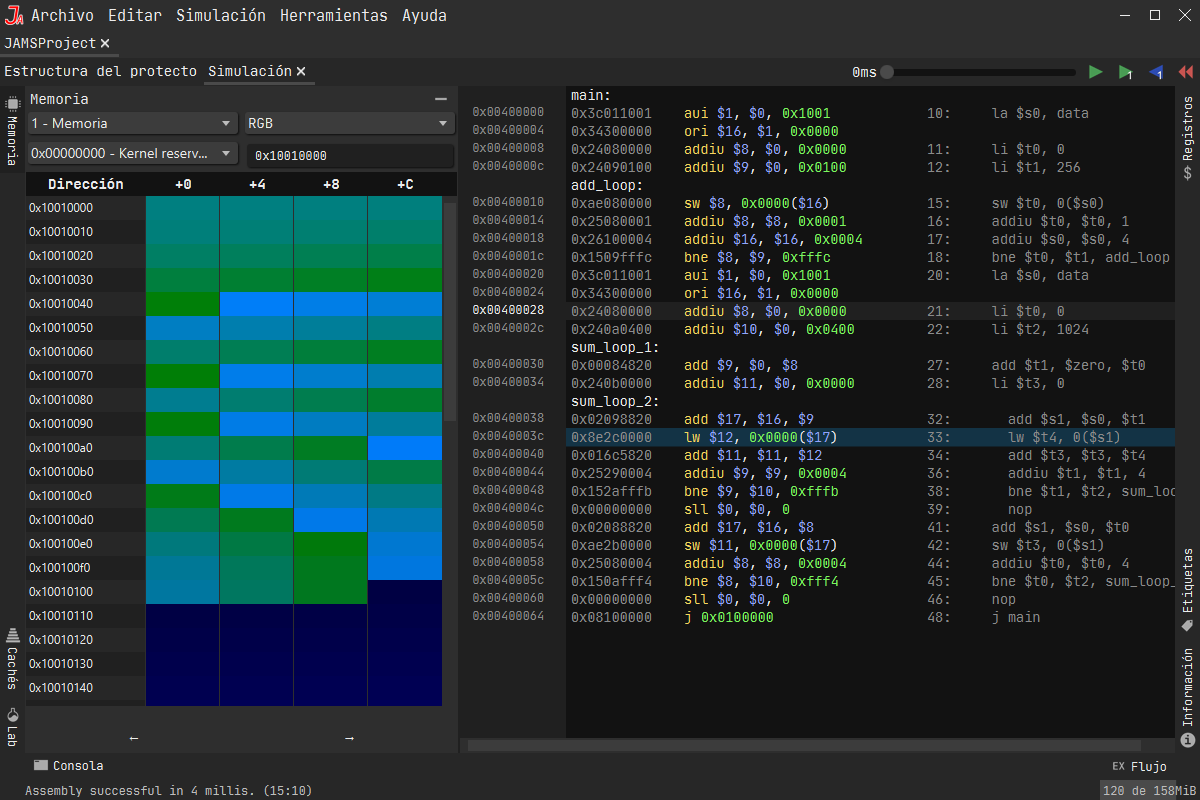
The core simulation loop is polymorphic, supporting three distinct micro-architectures that share a common memory and register backend:
- Single-Cycle: Optimized for raw throughput (>40 MHz). It executes the entire instruction fetch-decode-execute-writeback sequence in one atomic step.
- Multi-Cycle: Breaks down execution into finite state machine steps, allowing students to visualize the micro-operations occurring per clock tick.
- Pipelined (MIPS32): The most complex implementation. I
t simulates a 5-stage pipeline (IF, ID, EX, MEM, WB) with fully functional Hazard Detection and Forwarding Units.
- Configurable ALU Fabric: Unlike rigid simulators, JAMS allows users to define the execution stage hardware. You can customize the amount, type, and latency (cycles) of the ALUs.
- Structural Hazards: If the code requests an operation (e.g., Float Division) and no matching ALU is free, the simulator generates structural stalls, visualizing resource contention in real-time.
2. The Memory Hierarchy: Sparse & Paged
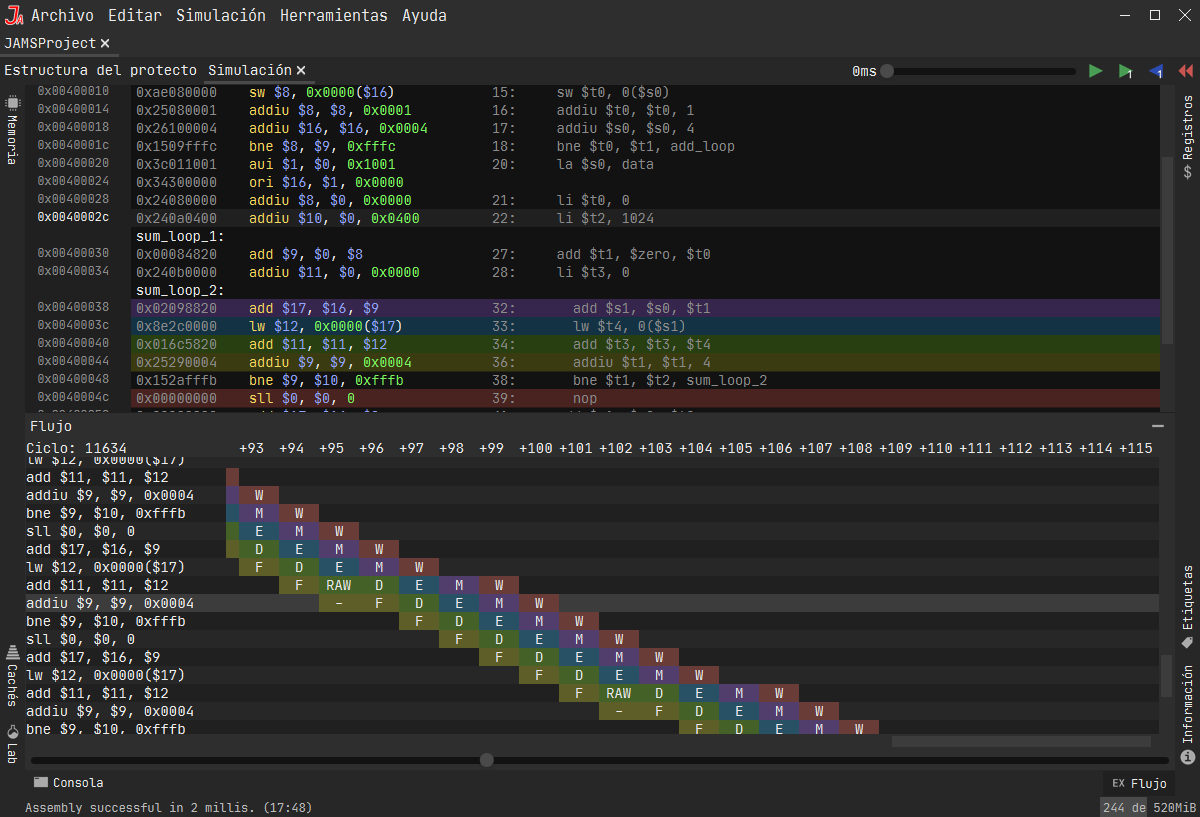
Simulating a full 32-bit address space (4GB) in a Java array (byte[4294967296]) is impossible due to heap limitations.
I architected a Sparse Memory System based on 4KB Pages.
- Lazy Allocation: Memory pages are allocated only upon the first write operation. Reading from unallocated space returns zero without consuming heap.
- Cache Simulation: JAMS sits a configurable Cache layer on top of RAM. It supports Direct Mapped, Set-Associative, and Fully Associative configurations with Write-Through/Write-Back policies, allowing users to profile cache hit/miss rates.
3. Performance: The “Zero-Allocation” Policy
Java’s Garbage Collector (GC) is the enemy of consistent framerates in emulation. To achieve stable execution speeds of 40 Million Instructions Per Second (MIPS), the Single-Cycle engine enforces a strict Zero-Allocation Policy in the hot loop.
- Object Pooling: Instruction objects and event payloads are reused.
- Mutable State: Instead of creating new state objects per cycle, the engine mutates pre-allocated registers and signal buses in place.
- Result: This prevents GC pauses, ensuring the UI remains responsive even during intensive simulations.
Technical Challenges
Simulating 4GB Memory on the JVM
Simulating the full 32-bit MIPS address space (4 GB) using a primitive byte[] array causes immediate OutOfMemoryErrors or excessive heap usage, as most of the address space remains empty during execution.
I implemented a Sparse Paged Memory system. The address space is divided into virtual 4KB pages. Pages are lazily allocated only upon the first write operation. Reading from an unallocated page returns zero without consuming heap memory, allowing efficient simulation of full memory maps .
The Editor Latency Problem
JavaFX’s standard text components cannot handle large assembly files (10k+ lines) with real-time semantic analysis without freezing the UI thread during every keystroke.
I built an Asynchronous MVC Editor from scratch.
- Model: Replaced
Stringwith a Rope Data Structure for O(log n) editing. - Controller: Implemented “Edit Batching” to compress rapid keystrokes.
- View: The AST and Semantic Highlighting are computed on a background thread, updating the UI only when the analysis is complete.
Dependency Hell in Plugins
A modular system allows plugins to depend on each other (e.g., “NES4JAMS” depends on “MIPS-Core”).
Loading them in the wrong order causes ClassDefNotFound errors,
and circular dependencies create deadlocks.
I implemented a Dependency Graph Resolver that runs at startup.
It builds a Directed Acyclic Graph (DAG) of all discovered plugin.json manifests and performs
a Topological Sort to determine the strictly correct initialization order,
ensuring stability before loading any class.
Fighting the Garbage Collector
Achieving a consistent 40 MHz simulation speed in Java is difficult because creating millions of temporary objects per second (e.g., instruction wrappers, signals) triggers frequent “Stop-the-world” GC pauses, causing stuttering.
I enforced a strict “Zero-Allocation Policy” for the hot execution loop. Instead of instantiating new objects for every cycle, the engine uses Object Pooling and mutable singletons for signals and buses. This keeps the heap stable and ensures smooth, jitter-free execution.